Veterinary X-ray Equipment: A Complete Guide to Portable Units, Fixed DR Systems and Radiographic Tables
Walk into a small-animal clinic, a livestock veterinary station and an equine referral hospital, and you will find three completely different X-ray rooms. The house-call practitioner needs a unit that fits in a car boot. The busy pet clinic needs fast digital images with minimal retakes. The large-animal hospital needs enough penetration to image a horse’s abdomen through thick muscle and bone.
There is no single “best” veterinary X-ray machine — only the system that fits the animals you see, the space you have and the workflow you run. This guide walks through the main equipment categories, what each one is genuinely good at, and how to specify a system without paying for output you will never use.
At Newheek, we have spent 22 years manufacturing radiology equipment, from X-ray tube heads and high-voltage generators to complete DR systems and radiographic tables. Everything below comes from the machines we build and ship every day.
The Six Equipment Lines at a Glance
| Equipment line | Typical output | Best suited to |
|---|---|---|
| Handheld X-ray units | 140 W / 360 W / 900 W | Small-animal limbs, house calls, field emergencies |
| Portable X-ray units | 4 kW / 5 kW | Clinics without a shielded room; mobile workflows |
| Portable pet DR | 5 kW + 17×17 CsI wireless panel | Clinics wanting digital images in seconds |
| Fixed pet X-ray systems | 20–50 kW, up to 630 mA | High-throughput small-animal practices |
| Large-animal DR | 80 kW / 1000 mA | Cattle, horses, sheep; referral and research facilities |
| Veterinary radiographic tables | Fixed or mobile | Positioning for portable units or tube-head systems |
1. Handheld X-ray Units: Imaging Where the Patient Is
A handheld unit is not a compromise — it is the right tool when the patient cannot or should not be moved. Our 140 W and 360 W models weigh around 2 kg, while the 900 W version weighs 5.5 kg. All three run on battery, with a kV range from 40 kV up to 90 kV and exposure times from milliseconds to several seconds.
Where they earn their keep:
- Fracture screening in cats and small dogs
- House calls and nursing-home style visits
- Field work, farms and emergency scenes without mains power
- Screening before transport, so the animal is stable enough to move
Because exposure is triggered by remote hand switch or button, one operator can position the animal and shoot without a second pair of hands. If your caseload is mostly small animals and you travel to them, start here.
2. Portable X-ray Units: A Radiography Room Without Construction
The 4 kW portable unit is the workhorse of many small clinics. It uses a high-frequency inverter, offers 40–110 kV / 40–63 mA, and can be triggered by remote, hand switch or touchscreen. The unit itself is 19 kg. Add an optional mobile stand and a trolley case and the whole system can be moved between rooms or loaded into a vehicle for house calls.
The 5 kW series takes this further with five configurations, all around 5 kW output, weighing 14.5–22 kg, with kV ranges up to 125 kV and different focal spot and language options. The choice between them is usually about how you work, not raw power:
- Need the widest kV headroom? Look at Config A or B (40–125 kV).
- Need 110 V compatibility? Config C supports 220 V or 110 V.
- Need the lightest unit? Config E is 14.5 kg.
Optional accessories matter as much as the generator. A manual or motorised mobile stand, a foldable tripod for field use, or a fitted trolley case can turn a bench-top unit into a complete mobile radiography setup.
3. Portable Pet DR: Digital Images in About Three Seconds
Pairing a 5 kW generator with a 17×17 inch CsI wireless flat panel detector gives you a portable DR system: 3072×3072 pixels, 139 µm pixel pitch, 16-bit greyscale and roughly one-second acquisition. In practice, from positioning to an image on the workstation, you are looking at only a few seconds.
This is the most common upgrade path for clinics still using CR plates. The generator and table you already own can stay; the detector does the transformation. Our tables and DR systems accept both wired and wireless panels, including the NK4343Z (35×43 cm CsI), and we confirm compatibility with your existing detector before you order.
4. Fixed Pet X-ray Systems: Throughput for Busy Clinics
When the queue of patients is constant, a fixed system pays for itself in time saved. Our combined systems run from 20 kW to 50 kW, with current up to 630 mA, and can be configured with:
- A four-way floating tabletop with electromagnetic lock
- A tube head, high-voltage generator and collimator developed in-house
- Touchscreen control and veterinary exposure presets
- A cassette trolley accepting CR, DR and IP plates in different sizes
The four-way float is worth discussing on its own. With 90 cm of lateral and 40 cm of longitudinal travel, the operator glides the tabletop into position and locks it electromagnetically — no lifting the animal, no extra assistant, and far less motion blur. For a clinic doing dozens of views a day, that is the difference between a smooth schedule and a bottleneck.
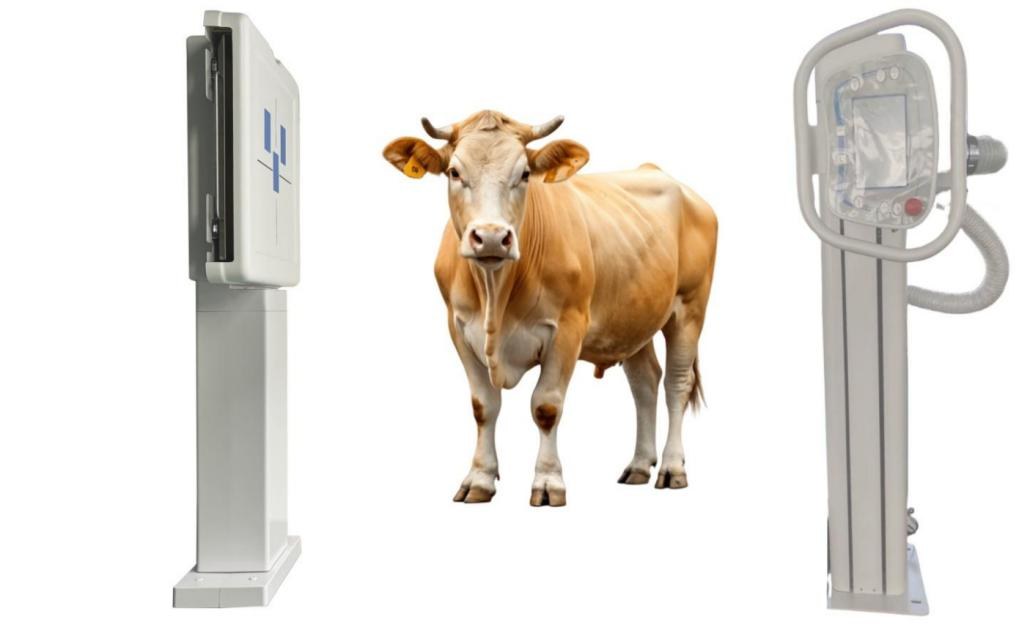
5. Large-Animal DR: 80 kW / 1000 mA for Horses and Cattle
Large-animal imaging is a different engineering problem. You are penetrating thick anatomy, often with an animal that cannot stay still for long. Our large-animal DR system delivers 80 kW and 1000 mA, with a kV range of 40–150 kV, exposure times from 1 to 10,000 ms and 1,840 APR preset sets.
The system is supplied with:
- A 2400-set X-ray tube (0.6/1.2 mm focal spot, 12° anode angle, 260/350 kJ heat capacity)
- A two-column tube stand with 0–153 cm column travel and ±90° arm rotation
- A CsI flat panel with 430×430 mm active area, 3072×3072 matrix and 1 s acquisition
- A bovine / equine / ovine restraint chute
Typical applications include locating swallowed foreign bodies in cattle, lameness and limb studies in horses, and reproductive or respiratory imaging in sheep. Referral hospitals, large farms and pharmaceutical research units are the usual buyers here.
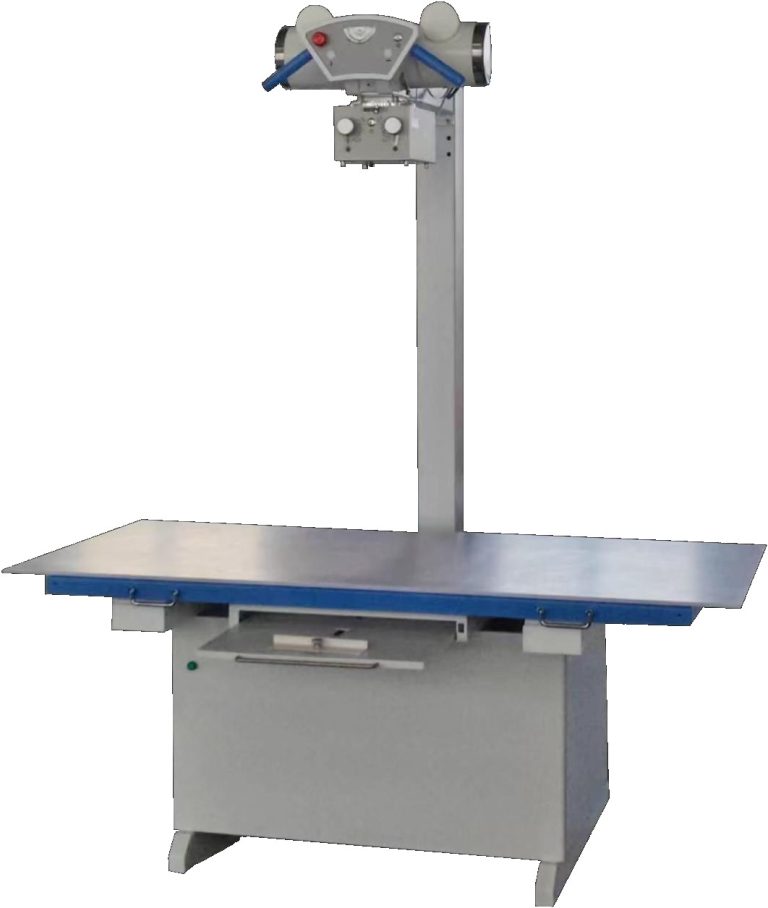
6. Veterinary Radiographic Tables: The Foundation of Good Positioning
A table is not just a platform — it determines how easily you can position an animal and how clean the resulting image is. Our NKPIBS range covers the main configurations:
By mounting
- For portable units — a separate column (NKPIIBS) or an integrated table; the bracket adjusts from 25.3 to 28 cm to fit different portable units
- For tube heads — a column carrying the generator, tube head and collimator, with three height settings
By mobility
- Fixed tables — compact footprint, no lead-lined room needed in many cases, ready to use in an ordinary consultation room
- Mobile tables — four casters let one table roll between radiology, wards and surgery; the radiology table by day, the bedside unit for hospitalised patients by afternoon
By tabletop material
- Acrylic — low radiation absorption, translucent for easy positioning, simple to disinfect
- MDF — economical and durable
- Polyurethane — comfortable for larger animals, easy to clean
Across the range you get four-way floating movement with electromagnetic locking, and a full-size cassette tray for CR, DR and IP plates. That last point is an upgrade insurance policy: when you move to DR, the table stays.
How to Choose: Match the System to Your Workflow
| If your typical day looks like this… | Start with… |
|---|---|
| House calls, farm visits, small-animal limbs | 140W / 360W handheld unit |
| A small clinic with no shielded room | 4 kW portable unit + mobile stand |
| CR plates today, digital tomorrow | 5 kW portable unit + wireless flat panel |
| 30+ small-animal views a day | 20–50 kW fixed system with floating table |
| Horses, cattle or sheep | 80 kW / 1000 mA large-animal DR |
| A working generator but poor positioning | NKPIBS radiographic table only |
A useful rule: buy for the animals you actually see, not the ones you hope to see. Output you do not use adds cost without adding images. If you are unsure, tell us the species, body parts and room dimensions — our engineers will recommend a configuration rather than the most expensive model.
What to Check Before You Buy
- Real output and kV range. Ask for the rated values, not a marketing peak figure. A 40–125 kV unit covers considerably more anatomy than a fixed 65 kV unit.
- High-frequency inverter. It gives steadier output, shorter exposure times and lower dose compared with older transformer designs.
- Detector compatibility. Confirm that the table or system works with your existing panel, wired or wireless, before placing the order.
- Positioning mechanics. Four-way float plus electromagnetic lock is the single biggest workflow upgrade in most clinics.
- Installation and training. Look for an English manual, quick-start guide and remote video support — not just a shipping box.
- OEM / ODM flexibility. As the manufacturer, we can print your logo, customise software languages, packaging and manuals, with a low minimum order quantity.
Why Buy Direct from Newheek
- 22 years focused on radiology equipment manufacturing
- 30+ veterinary models in production, from a 2 kg handheld unit to an 80 kW large-animal DR
- Core components — tube heads, generators, collimators and tables — made in-house
- Factory-direct pricing with no middleman markup
- Export experience across many countries, with CE and RoHS certification on selected product lines
- Free remote installation and operation training, plus lifetime technical support by WhatsApp and email
Every machine is burn-in tested and image-QC checked before shipment, packed in a wooden case, and shipped with tracked logistics.
Frequently Asked Questions
How much does a veterinary X-ray system cost?
It depends on configuration. Send us the model you are considering — handheld, portable, fixed DR or table — and you will receive a factory-direct quotation within 24 hours. Distributors and multi-unit orders qualify for additional discounts.
Do you support OEM / ODM?
Yes. We can apply your logo, customise software languages, packaging and manuals. Send your brand requirements and we will confirm feasibility within one working day.
Do you provide installation and training?
Every machine ships with an English manual and quick-start guide. Our engineers provide free remote video installation and operation training, along with lifetime technical support.
Which flat panel detectors are supported?
Our tables and DR systems work with both wired and wireless panels, such as the NK4343Z (35×43 cm CsI). Tell us your detector model and we will confirm compatibility before you order.
Can I upgrade from CR to DR later?
Yes. Our tables accept CR, DR and IP plates, and the generator can be paired with a wireless panel. You do not need to replace the table to go digital.
Ready to Spec Your System?
Tell us which species and body parts you image most, and we will match the right model and configuration — with full specifications, sample images and a quotation within 24 hours.
Email: admin@newheek.cn
Tel / WhatsApp: +86 19062611512
Location: Weifang, Shandong, China · Hours: 24/7 inquiry support
Newheek — veterinary X-ray imaging equipment, factory direct.